

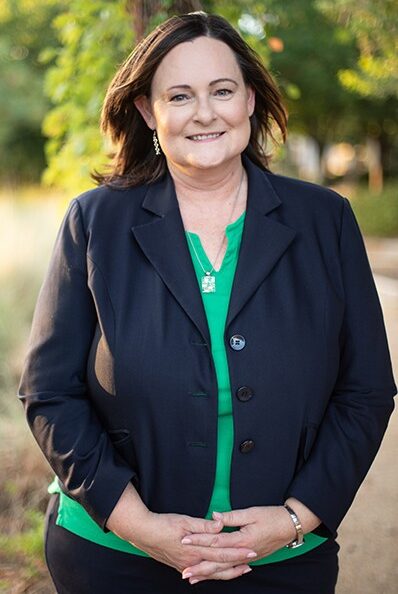
Keri K. Stephens, Ph.D., Co-Director of the Technology and Information Policy Institute (TIPI) and the George Christian Centennial Professor in Organizational Communication and Technology at The University of Texas at Austin, has received the 2026 Gerald M. Phillips Award for Distinguished Applied Communication Scholarship from the National Communication Association (NCA). The Phillips Award recognizes researchers whose scholarship improves how people communicate in the settings where they live and work
For more than 25 years, Stephens has studied how people communicate around disasters, including the importance of having reliable data and when the technologies they depend on break down. Her research spans organizational communication, mobile technologies, artificial intelligence, crisis and disaster communication, and infrastructure communication. Communities facing floods and wildfires have used her findings to build better warning and preparedness systems. At TIPI, Stephens leads teams of faculty, graduate students, and community partners who turn these questions into research that people can put to use.
Helping Texas Understand Flood Risk
Texas ranks first in the nation for the variety and frequency of its natural disasters. Her teams have received funding from the Texas Water Development Board and the Texas General Land Office to better understand how people make flood-related safety and property decisions, and they have developed flood communication products for their partnering communities. Through the Communicating Flood Risk for Texas project, the team created a resource guide for local flood officials and designed flood awareness messages for four groups: newcomers to Texas, men ages 18 to 35, older adults, and Spanish speakers. The team also developed guidelines for communicating and visualizing flood risk as part of the Texas Integrated Flooding Framework. A 2026 study of more than 1,000 Texas drivers examined how “Turn Around Don’t Drown” road signs relate to decisions to drive into flooded roads.
Building Data with Communities
Stephens also worked with colleagues at Texas A&M University and UT Austin to establish and build DRIP, the Disaster Resilience Information and Partnership Program. In one of the inaugural DRIP projects, the team worked with local residents in Fort Hancock, Texas, to create photographic evidence of their repetitive flooding. The team published this work in the Journal of Applied Communication Research, and the study received the IBM Future Shocks Case Study Award in 2025.
Keeping Water and Power Messages Clear in Extreme Weather
After Winter Storm Uri in 2021, Stephens and an interdisciplinary team funded by the National Science Foundation studied how water and power utilities and the communities they serve communicated during the crisis. That extreme weather infrastructure communication work led to a second NSF project with partners in El Paso, where the team designed and tested utility messages for Spanish-speaking residents and older adults. Spanish-speaking participants reported more willingness to follow water conservation advisories, especially when messages gave them choices about which actions to take. The study received a Top Paper Award from the Environmental Communication Division of the International Communication Association in 2025.
Pairing People and Technology in a Crisis
Stephens has long studied what happens when official systems fall short. Her research after Hurricane Harvey showed how residents turned to social media networks to seek rescue, work she later shared in a TEDx talk. Her NSF-funded human-AI teaming research trains community members to work alongside expert systems that identify disaster risks on social media, giving emergency managers better awareness of what is happening on the ground. Her current work examines how experts can keep their own judgment when they rely on artificial intelligence during emergencies.
Preparing Neighborhoods for Wildfire
Her study of a community-led wildfire evacuation drill earned awards from the Texas Association of Counties and the National Association of Counties.
Stephens has published more than 150 peer-reviewed articles and five books, including The Handbook of Infrastructure Communication (Wiley, 2026) and The Social Scientist’s Grant Guide (Bloomsbury, 2026). As a principal investigator or co-principal investigator, she has secured more than $10 million in external funding from the National Science Foundation, Texas state agencies, and industry, and she is Sr. Personnel on a newly funded $29 million NSF award on Human-Robot Coadaptation. She is a Fellow of the International Communication Association and a UT Austin Distinguished Teaching Professor.
A Word from Keri Stephens
This award belongs to the communities who invited us in. The residents, committed local leaders, and emergency managers we work with showed us that people closest to a hazard hold the knowledge that official data misses. At TIPI, our teams bring that knowledge together with careful research so that warnings, advisories, and flood information make sense to the people who need them.